CUSTOMER SUPPORT
087 711 5767
087 711 5767

Scandinavian lighting has one of the clearest, most consistently agreed-upon definitions of any style in this series: pale woods, clean shapes, and a gentle, natural glow, built for interiors that stay bright and airy without ever tipping into cold. Where this article earns its place is in the detail that gets skipped everywhere else, the actual engineering behind why Scandinavian lighting feels warm and comfortable despite being one of the brighter, whiter styles in the category. It comes down to how the light is diffused, not just what colour the fittings are.
Our Scandinavian lighting collection covers what defines the look and how it differs from Japandi in brief. This article goes further into the practical side: how to actually apply the style room by room, and the specific technical reason it avoids feeling clinical.
Most style guides talk about Scandinavian lighting purely in terms of aesthetics, pale wood, matte white, clean silhouettes. What actually makes the style work in a room is glare reduction, and it's worth understanding briefly why.
An exposed bulb or a hard, undiffused shade throws a harsh, directional beam with a visible hotspot, the kind of light that's uncomfortable to look at directly and creates sharp shadows across a room. Scandinavian fittings are engineered specifically to avoid this. Opal and frosted glass scatter light evenly across the whole surface of the shade rather than letting it concentrate at one point, and indirect or upward-facing fixtures bounce light off a ceiling or wall before it reaches the room, softening it further still.
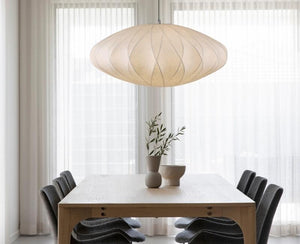
The Bubble Eclipse White Fabric Pendant Light is a strong example of this principle taken to its logical extreme, an oversized fabric drum that diffuses genuinely soft, ambient light rather than acting as a harsh point source. The Bells White or Black Tube Pendant Light achieves something similar in a slimmer, more minimal silhouette, useful where a full drum shade would feel too heavy for the room.
This is the detail that sets Scandinavian lighting apart from styles built around exposed filaments and visible bulbs. It's not simply a lighter colour palette, it's a genuinely different approach to how the light itself behaves once it leaves the fitting.
If the Japandi guide established 2700K as its warm baseline, Scandinavian lighting generally sits a touch cooler and brighter, in the 3000K to 3500K range. This is what gives the style its characteristic clean, airy, daylight-adjacent quality without drifting into the harsh, clinical whiteness of 4000K and above.
It's a narrower, more specific range than it might sound. Stay below 3000K and a room starts to skew toward Japandi's deeper warmth. Push past 3500K and the crisp, comfortable Nordic quality gives way to something closer to an office downlight. The sweet spot in between is what keeps a Scandinavian room feeling bright without feeling sterile.
Kitchen and dining. A single pendant over the table or island works as the room's anchoring statement, exactly the role Scandinavian design is built for. The Charlotte Nordic Wood and Steel Pendant Light pairs natural wood with aluminium for a calm, considered look that reads as neither cold nor overly rustic, a genuinely balanced middle ground. The Nordic Plain Metal Pendant Light offers a simpler, more understated alternative across two sizes for a smaller kitchen table.
Bedroom. Paired wall sconces flanking the bed are a genuinely useful, specific substitute for a single overhead fitting, giving each side of the bed independent, softly diffused light rather than one central source that floods the whole room. The Newton Antique Brass Arm Wall Light with Cord and Plug works well here, since its plug-and-go design and moveable arm suit exactly this kind of bedside application without needing an electrician for a straightforward retrofit.
Living room. Floor lamps with opal glass diffusers give a room even, glare-free ambient fill without a single harsh point of light anywhere in the space. Browse the collection's floor lamp range directly for the current options suited to this application, since the right scale depends heavily on the room.
Scandinavian lighting is one of three closely related styles in this series, and it's worth being precise about where it sits rather than treating all three as interchangeable. Scandinavian on its own skews brighter and whiter, generally without the deeper wood tones and lower 2700K warmth that define Japandi. Warm minimalism sits on the other side of Scandinavian again, deliberately softening that brighter, whiter baseline into something more tonal and muted. Scandinavian is the middle point: brighter than Japandi, less deliberately softened than warm minimalism, but never cold in the way a purely clinical white space would be.
One genuine strength of Scandinavian lighting, and part of why it's worth investing in properly, is that it doesn't date the way trend-led styles do. Its restrained forms and neutral materials work equally well in a minimalist home, a Japandi-leaning room, a mid-century interior, or a straightforwardly contemporary space, without ever looking like it was chosen for a specific moment. A well-chosen Scandinavian pendant bought today will still make sense in a room redecorated five years from now, which isn't something every style in this series can claim.
Does Scandinavian lighting work with warmer, non-white interiors? Yes. While the style's baseline is pale and bright, its restrained forms and natural materials pair well with warmer wall colours and richer furniture, since the fittings themselves stay neutral enough to sit comfortably against a warmer backdrop rather than clashing with it.
What makes Scandinavian lighting different from generic minimalist lighting? Generic minimalist lighting is defined mainly by simplicity of form. Scandinavian lighting adds a specific material and technical layer on top of that simplicity, pale woods, opal or frosted glass, and fittings engineered specifically to diffuse light and reduce glare, rather than simplicity for its own sake.
What colour temperature works best for Scandinavian lighting? Aim for the 3000K to 3500K range. This keeps a room feeling bright and airy without drifting into the deeper warmth of styles like Japandi or the harsher, clinical whiteness of anything above 3500K.
Browse the full Scandinavian lighting collection at Lighting.co.za for pendants, wall lights, and lamps built around understated, Nordic-inspired design. Nationwide delivery is available across South Africa.