

On the evening of 15 May 2026, South Africans across the country did something they hadn't done in years: they went to bed without checking an app. No schedule. No stage. No midnight alarm for when the power was due back. At midnight, Eskom quietly completed 365 consecutive days without loadshedding — a full year without cuts, the first time that's happened since September 2018. Over the three years leading up to it, that improving reliability saved an estimated R26.9 billion in diesel costs alone.
For most South African households, the moment itself passed without ceremony. But it marks something real: the crisis years are behind us, at least for now, and the provisional, improvised, make-do lighting arrangements most of us lived with through them deserve a second look. This article is that second look.
What loadshedding did to SA home lighting
Set the scene honestly, because most readers will recognise themselves in it. During the worst years of loadshedding — Stage 4, 5, 6, twelve-hour cuts in some areas — SA homes assembled a patchwork of solutions that were never meant to be permanent. Rechargeable lamps on every surface. Low-wattage LED circuits wired to the inverter. Rooms deliberately under-lit to stretch battery life a little further. A bedside table lamp swapped out for a camping lantern. Pendant lights that never got installed, because what was the point if it was all going to go off anyway.
The result, in a lot of SA homes, is lighting that was optimised for survival rather than for living. It worked. It got people through the crisis. But it doesn't reflect how people actually want their homes to look and feel — and now, for the first time in years, there's a stable grid worth investing against.
What to keep from the loadshedding era
Not everything from the crisis years needs retiring. Some of it earns a permanent place in the home — just used a little differently.
Rechargeable table lamps. The rechargeable lamp was the defining lighting product of the SA loadshedding era — portable, cordless, no cable to manage, running six to eight hours on a single charge. In a crisis, it was survival equipment. In a stable-power home, it turns out to be something else entirely: one of the most versatile and genuinely good-looking accent lights available. A rechargeable lamp on a coffee table, a dining table, a bedside, or an outdoor entertaining area is a real design choice, not a compromise. Loadshedding introduced millions of South Africans to a product category they'd probably never have bought otherwise, and it turned out to be an excellent one. Keep it — just stop thinking of it as emergency kit.
Solar garden lights. Many homes installed solar spike lights, path lights, and bollards to keep outdoor areas usable when the grid was down. In a post-loadshedding garden they remain exactly as useful — they charge off the sun regardless of what the grid is doing, need no wiring, and give the same path and perimeter lighting they always did. If they're still working, there's no reason to pull them out.
The habit of thinking about lighting. This is the unexpected upside of living through a lighting crisis: most South Africans now think about their home lighting in a way they never used to. They know what it feels like to be without it. They understand that different rooms need different amounts of light, that warm light suits relaxing and cooler light suits working. That awareness was hard-won, and it's worth holding onto — there's just a stable grid to apply it against now.
What to rethink
These are the compromises loadshedding forced on SA homes that no longer need to be compromises.
Under-lit rooms. During peak loadshedding, plenty of homeowners made a pragmatic call: light fewer rooms, keep the inverter load down, stretch the battery. The result is homes that are still consistently under-lit — a single downlight in a living room that really needs three, a bedroom pendant running a 5W bulb where 9W is needed, a kitchen that goes dark at the prep counter because the under-cabinet strip was wired to the main circuit rather than the inverter. Now is the moment to walk through every room with fresh eyes and ask honestly: is this lit the way I actually want it, or the way loadshedding taught me to accept?
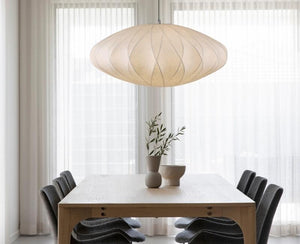
The "good enough" pendant. Plenty of lighting upgrades got deferred during the crisis years — why invest in a statement pendant when you'd be staring at a dark ceiling for half the evening anyway? The logic was entirely rational at the time. The result is homes still full of temporary, placeholder, or builder-spec fittings that were never meant to be permanent. Post-loadshedding is exactly the moment to make the decision that got put off: the pendant over the dining table, proper bedside lights on both sides of the bed, the feature light in the entrance hall that was going to make the house feel like home.
The inverter-circuit hierarchy. Loadshedding-era homes developed an implicit priority order — lights on the inverter circuit, everything else on the main. That usually meant the most-used rooms stayed well lit (lounge, kitchen, main bedroom) while secondary spaces got neglected (study, guest room, second bathroom). That hierarchy was a crisis adaptation. It doesn't need to be the permanent shape of the home's lighting.
What to upgrade now
Frame each of these as the decision that got deferred during the crisis and is now genuinely worth making.
The layered living room. Most SA living rooms came out of the loadshedding years with a single overhead circuit and one or two rechargeable lamps propped in the corners. Now is the time to add the layers: a statement pendant over the seating area, a floor lamp in the corner — the Mason Black and Glass Lantern LED Floor Lamp makes an immediate difference — and wall sconces if the room allows for them. The rechargeable lamp stays; it just becomes the warm table layer rather than the primary source of light.
Proper bedside lights on both sides. The bedside situation in a lot of SA bedrooms during loadshedding was improvised — a rechargeable lamp on one side, a phone torch on the other. A proper bedside light on both sides of the bed, ideally wall-mounted to free up the bedside table, is one of the most immediately felt quality-of-life upgrades a bedroom can get. The Kin Square LED Bedside Reading Wall Light gives a proper reading beam plus a soft back glow — worth doing now, on both sides.
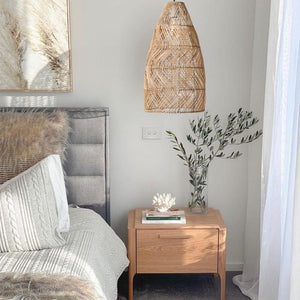
The entrance hall statement. The entrance hall is where a home makes its first impression, on guests and on the people who live there. It was often the lowest priority during loadshedding, since it's rarely the room anyone huddled in with a lantern. Now it deserves the fitting it always should have had — a chandelier like the Bali Black 8 Light for a strong statement, or something warmer and more understated like the Adaya Small Rattan Pendant at a gentler price point.
Under-cabinet kitchen lighting. Under-cabinet LED strip lighting was frequently left off inverter circuits during loadshedding — it felt like a luxury the load couldn't justify. It isn't a luxury. It's one of the most practical kitchen upgrades available, and installing an LED strip kit at the prep counter now, with a stable grid behind it, is well worth doing.
The outdoor area. SA's stoeps, patios, braai rooms, and garden terraces were often left in the dark during loadshedding, or lit by solar lights pressed into service well beyond what they were designed for. Now is the time to do the outdoor lighting properly — outdoor wall lights like the Paso Doblo Slatted Up Down at eye level, downlights in the patio ceiling, a warm pendant over an outdoor dining table. A stable grid finally makes a proper hardwired outdoor circuit worth the investment.
An honest word about the rechargeable lamps
The rechargeable lamp didn't disappear when loadshedding ended, and it shouldn't. But its job should change. During loadshedding it was a primary light source, a survival tool, a practical necessity. In a post-loadshedding home it's something better: a design accent, a portable light for wherever warmth is needed, a table lamp that doesn't need an outlet nearby, an outdoor light for braai nights and long dinners on the stoep.
The best of the rechargeable lamps — the ones with a warm colour temperature, good dimming, and a considered design, like the Oliver Rechargeable Table Lamp or the marble Ping Rechargeable Table Lamp — are genuinely excellent products that belong in a well-lit home regardless of grid stability. The ones bought purely for crisis management — camping lanterns, cheap single-mode lights with no dimming — can be retired to the garage camping box, where they belong.
The distinction worth making: if a rechargeable lamp in your home looks good and adds something to the room, keep it exactly where it is. If it still looks like emergency equipment, it's time to replace it with something that belongs there by choice — the Ella or Acris rechargeable lamps are a good place to start.
The bigger picture
South Africans spent years making lighting decisions on the assumption that the power would go off. Every investment, every deferred upgrade, every "what's the point" was shaped by that assumption. For the moment at least, that assumption no longer holds.
A stable grid doesn't just mean the lights stay on. It means lighting decisions can be made for how a home should look and feel, not for how it will survive a six-hour cut. It means a pendant over the dining table is worth having, because it'll actually be on every night. It means investing in a layered, considered living room makes sense, because the atmosphere it creates will actually exist to enjoy.
That's a fairly significant thing to be able to say after eight years: your home's lighting can now be designed for living, not just for surviving.
Making the most of it
If you've been living with loadshedding-era lighting and it's time to properly light your home for the first time in years, start room by room — bedroom, living room, dining room, and patio — and keep the best of what the crisis years taught you, from the rechargeable lights range upward. Nationwide delivery is available across South Africa.
The lights are on. Make the most of it.


