CUSTOMER SUPPORT
087 711 5767
087 711 5767

A mirror doesn't make light. It moves it. Hang the same mirror in two different spots in the same room and you'll get two completely different results, one that bounces the last of the afternoon sun across the whole space, and one that just reflects a blank wall back at itself. Of everything in this decor series, mirrors are the piece most directly tied to how a room is lit, because unlike a cushion or a coffee table, a mirror is actively doing something to the light around it.
This is the second post in our series on the decor that sits alongside your lighting, following on from scatter cushions. Here's how to choose a mirror properly, and how to place it so it's actually working with your light instead of against it.
A mirror's main practical job is to bounce available light around a room, brighten a dark corner, and create the illusion of more space than you actually have. But it can only do that if it's placed where it can reflect something worth reflecting.
The single biggest placement mistake is hanging a mirror opposite a blank wall. It'll still look fine as an object, but it isn't doing any of the actual work a mirror can do. Position a mirror to face a window, a light fitting, or an open part of the room instead, and it starts multiplying whatever light is already there rather than just repeating a dead corner back at you.
This is exactly why mirrors and lighting deserve to be chosen together rather than as two separate shopping trips. A mirror placed to catch the glow of a pendant or a wall light in the evening does something a mirror facing a bare wall never will.
Everything above applies to a plain reflective mirror. A growing part of the mirror category now builds the light source into the mirror itself instead, which changes the calculation: a backlit mirror isn't just reflecting the room's light, it's generating its own, which makes it a far safer choice for a hallway, entrance, or reading nook that doesn't get much natural or ambient light to begin with. We've covered the full LED-versus-standard decision, including frontlit, backlit, and edge-lit differences, in a dedicated guide.
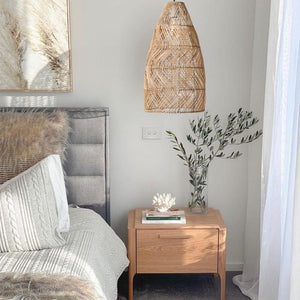
Round, arch, pill, and organic shapes all catch and reflect light a little differently, which is worth knowing before you choose one purely on looks. We've covered which shape actually suits which room and style in a dedicated shape guide, so we won't repeat the full breakdown here. One point worth flagging on its own: wood-framed mirrors bring a warmth into a space that metal frames don't, and pair particularly well with rattan and natural fibre lighting covered elsewhere in this series.
A bathroom mirror does a different job to a decorative wall mirror. For grooming and vanity use, light needs to come from the front and sides of the face, not just from above, which is why so many bathroom mirrors now build the light source into the mirror itself. We've covered bathroom mirror height and lighting in full, including front-lit versus backlit for grooming and where a demister earns its keep, in a dedicated bathroom guide.
Entrance halls and foyers are the classic spot for a statement mirror, since this is the first impression of the whole home and a mirror instantly makes a small entrance feel larger and better lit.
Opposite or beside a window is where a plain mirror does its best work, bouncing daylight further into a room than the window alone ever could.
Above a console or side table pairs naturally with a table lamp beneath it, since the mirror will pick up and reflect that lamp's glow back into the room once the sun goes down, effectively doubling the light from a single small fitting.
Dark hallways and passages benefit more from a backlit mirror than a plain one, since these are often the rooms with the least natural or ambient light to reflect in the first place.
As a rough guide, a mirror hung above a console, vanity, or side table should be roughly two-thirds the width of the surface beneath it. For the full room-by-room and shape-by-shape breakdown, see our mirror sizing guide.
What's the difference between a decorative mirror and a bathroom LED mirror? Decorative mirrors are purely reflective pieces suited to hallways, bedrooms, and living areas, while bathroom LED mirrors have lighting built directly into the mirror for grooming and vanity use.
Does a mirror actually make a room brighter, or does it just look that way? A mirror genuinely increases the amount of usable light in a room, provided it's positioned to reflect an actual light source, whether that's a window, a lamp, or a light fitting, rather than a blank wall.
Which rooms suit a large decorative mirror? Hallways, foyers, bedrooms, and living areas all benefit from a large mirror, which enhances natural light and creates the illusion of a bigger space.
Can mirrors be made to a custom size in South Africa? Yes, locally manufactured mirrors are available made to order, giving more flexibility on size, shape, and finish than the ready-to-ship range alone.
Browse the full decorative and LED mirror range at Lighting.co.za, or head straight to bathroom mirrors for grooming and vanity options specifically. This is one piece of a fuller mirror guide series: what size mirror do I need, LED mirror vs standard mirror and best shape for your space, and how high should a bathroom mirror hang, all worth a look if you want the full picture before you buy. And if you haven't already, catch up on the first post in this series on choosing scatter cushions. Nationwide delivery is available across South Africa.