Pendant Light Buying Guide
How to choose the right pendant light

087 711 5767
How to choose the right pendant light
Pendant lighting is one of the most effective ways to add both function and design to a room. The right pendant can transform a kitchen island, create atmosphere above a dining table or add character to an entrance hall.
If you are planning to add pendant lighting to your home, here are the key things to consider before making your choice.

Pendant lights are one of the most versatile lighting choices in a home. Whether suspended above a kitchen island, dining table, bedside table or entrance hall, a well-chosen pendant light can define a space, add warmth and bring a sense of design to the room.
While many people begin by choosing a pendant based on style, the most successful lighting decisions come from considering how the light will function in the space. Height, brightness, colour temperature, scale and placement all play a role in choosing the right pendant.
If you are planning to add pendant lighting to your home, here are the key things to consider before making your choice.
Pendant lights can serve several different purposes depending on where they are installed. Some pendants are used primarily for ambient lighting, providing soft general illumination in a room. Others are used as task lighting, particularly above kitchen islands, countertops or dining tables where focused light is helpful. Decorative pendants can also act as design features, drawing the eye and adding character to the space.
Before choosing a pendant, think about what you need the light to do. A pendant above a dining table, for example, may focus on atmosphere, while a pendant above a kitchen island needs to provide practical light for preparing food.

CLUSTER PENDANT LIGHTS combine multiple pendant lights suspended from a single ceiling plate, creating a striking focal point with layered illumination.
They're ideal for double-volume entrances, stairwells, voids, and rooms with high ceilings, where their scale and cascading design add visual impact.
Available in a variety of modern, contemporary, and decorative styles, cluster pendant lights provide both ambient lighting and a dramatic design statement, making them a popular choice for residential and hospitality interiors.

SINGLE PENDANT LIGHTS are perfect for creating a stylish focal point while providing targeted illumination. They work beautifully above dining tables, kitchen islands, breakfast nooks, bedside tables, and in entrance halls, where a single decorative fitting can define the space.
Available in Bohemian, modern, industrial, Scandinavian, Japandi, classic, and contemporary styles, single pendant lights offer a versatile lighting solution for both task lighting and ambient lighting in homes and commercial interiors.

MULTIPLE PENDANT LIGHTS are designed to be installed in a row, making them ideal for kitchen islands, breakfast bars, long dining tables, and countertops.
Using two or three pendants helps distribute light evenly while creating a balanced, symmetrical look. Correct spacing and hanging height are key to achieving both effective task lighting and a polished, well-proportioned design.

MINI PENDANT LIGHTS are compact pendant lights designed for smaller spaces where style and focused illumination are equally important. They're ideal above breakfast bars, bedside tables, small kitchen islands, vanities, and reading nooks, providing effective task lighting without overwhelming the space.
Available in a wide range of modern, Scandinavian, Japandi, industrial, and decorative styles, mini pendants are perfect for adding character to compact interiors.

The correct hanging height is one of the most important factors when installing pendant lights.
For dining tables and kitchen islands, pendant lights are typically installed 70–90cm above the surface. This height provides good illumination for the table while keeping the light comfortable for people seated or standing nearby.
For entrance halls or open areas, pendants can hang higher depending on the ceiling height and the size of the fitting.
If the pendant hangs too low it may obstruct views or feel intrusive. If it hangs too high the light can lose its visual impact and effectiveness.

This depends on the length of the surface below and the size of the pendant itself.
For kitchen islands, a common approach is:
-Two pendants for smaller islands
-Three pendants for longer islands
-One larger statement pendant for compact spaces
Spacing between pendants is important for visual balance. As a general guideline, pendants are usually spaced 60–75cm apart, but this can vary depending on the size of the fittings and the island.
The goal is to create even lighting while keeping the design visually balanced.

The size of your pendant light is just as important as its style. A well-proportioned pendant creates balance within a room, while the wrong size can make the space feel either empty or overcrowded.
When choosing a pendant light, consider the size of the dining table, kitchen island, breakfast bar, or open area beneath it. A pendant that's too small may disappear visually, while one that's too large can overwhelm the room and nearby furniture.
For dining rooms and kitchen islands, the pendant should generally be proportionate to the surface below, leaving enough space around the edges for a comfortable, balanced look. In double-volume spaces or rooms with high ceilings, larger pendant lights or cluster pendants often create greater visual impact while providing better overall illumination.
This approach helps you achieve a pendant light that looks intentional, complements your space, and provides the right amount of light for everyday living.
Colour temperature plays a big role in the mood of a room. It is measured in Kelvin (K).
For most homes, 2700K–3000K warm white lighting creates a welcoming and comfortable atmosphere. This is ideal for dining areas, bedrooms and living spaces.
In kitchens or workspaces, a slightly more neutral tone such as 3000K–4000K can provide clearer visibility for tasks like cooking and food preparation.
Warm white is usually the most popular choice for decorative pendant lighting because it helps create a relaxed and inviting environment.

The material and finish of a pendant light play an important role in both its appearance and the quality of light it produces. Whether you're designing a modern kitchen, dining room, bedroom, or entrance hall, choosing the right combination helps create a cohesive interior.
Glass pendant lights allow more light to pass through, making them ideal for smaller rooms or spaces where you want an open, airy feel. Metal, ceramic, fabric, rattan, timber, and stone-look pendants provide more directed lighting and add texture, warmth, and character to your décor.
Popular finishes such as brushed brass, matte black, chrome, nickel, white, and natural wood can be matched to cabinetry, furniture, tapware, and door hardware for a balanced, coordinated look. When selecting a pendant light, consider not only the style of the fitting but also how its material, finish, and light output will complement the room and your overall lighting design.
Pendant lighting is one of the most effective ways to add both function and design to a room. The right pendant can transform a kitchen island, create atmosphere above a dining table or add character to an entrance hall.
When choosing pendant lighting, it helps to think about purpose, placement, height, brightness and scale— not just style alone.
By balancing these elements, you can select pendant lights that not only look beautiful but also work perfectly for the way you use your space.
At Lighting.co.za, we always recommend choosing pendant lights that complement both the room and your lifestyle. The right pendant should feel natural in the space — enhancing the room while providing the light you need.
Create clean, continuous lighting with the X System LED Linear Black Profile CCT Pendant Light, available in four sizes. Its slim black profile and...
View full detailsCreate clean, continuous lighting with the X System LED Linear Black Profile CCT Ceiling Light, available in four sizes. Its slim black profile and...
View full detailsLinear joint for use with the X-System Linear. It works with either the pendant version or the ceiling and wall surface-mounted profiles. Product ...
View full details90° Corner joint for use with the X-System Linear. It works with either the pendant version or the ceiling and wall surface-mounted profiles. Produ...
View full detailsThe X System Black Linear CCT LED Profile T Joint splits a X System Linear LED profile run in three directions from a single junction, in an alumin...
View full detailsA remote-adjustable colour temperature lets one fitting suit a bright morning kitchen and a warm evening dinner alike, the Ceta Rectangular Pendant...
View full detailsA remote-adjustable colour temperature lets one fitting suit a bright morning kitchen and a warm evening dinner alike, the Marlow Pendant is a meta...
View full detailsThe Marrabella 3 Light Ceramic and Glass Cluster Pendant Light brings sculptural detail and soft illumination to your interior. Three pendants hang...
View full detailsThe Marrabella Style 3 Ceramic and Glass Pendant Light pairs softly ribbed opal glass with stacked lace blue ceramic detailing for a beautifully ba...
View full detailsThe Marrabella Style 2 Ceramic and Glass Pendant Light combines sculptural form with a beautiful mix of ceramic detailing and softly diffused glass...
View full detailsThe Marrabella Style 1 Ceramic and Glass Pendant Light blends sculptural ceramic detailing with softly diffused glass for a warm, inviting glow. It...
View full detailsAn antique brass head lends a restorative finish to a small dome-cut glass shade, the Hazel style 2 Pendant is a metal and glass fitting in clear, ...
View full detailsBring natural texture and bold contrast into your space with the Nedira Woven Natural and Black Rattan Pendant Light. Its rounded woven shade combi...
View full detailsThe Tahoe Clear Bell Glass Pendant Light pairs a beautifully shaped transparent glass shade with your choice of Antique Brass or Antique Silver. It...
View full detailsCeleste is around glass ball hanging lamp, in clear glass, adds full moon brilliance to old -fashion or modern settings. The glass shade is handmad...
View full detailsThe Tokai Style 1 White Wire Shade Pendant Light combines an artistic, flowing wire frame with a soft white inner diffuser. Its wider sculptural si...
View full detailsThe Tokai Style 2 Long White Wire Shade Pendant Light features an elegant sculptural wire frame with a soft white diffuser. Its elongated silhouett...
View full detailsInfuse style and functionality into your home with the Tokai Style 3 Long White Wire Shade Pendant Light. Features a tall cage shade, giving a uniq...
View full detailsInfuse style and functionality into your home with the Tokai Style 4 Long White Wire Shade Pendant Light. Features a tall cage shade, giving a uniq...
View full detailsThe Cloud Black Organic Pendant Light from Spazio is a harmonious blend of organic and modern design. Crafted from natural materials, it exudes a s...
View full detailsThe Woodra Slim Linear Wood Dimmable LED Pendant Light from Spazio brings warmth and modern simplicity to contemporary interiors. Featuring a slim ...
View full detailsDraw your eye to the simplistic design of the Lignum Slim Linear Wood Dimmable LED Pendant Light from Spazio. Hang this in your office, kitchen or ...
View full detailsDraw your eye to the simplistic design of the Wude Natural Ash or Walnut Dimmable LED Linear Pendant Light from Spazio. Hang this in your office, k...
View full detailsDraw your eye to the simplistic design of the Soren Natural Ash or Walnut Wood Linear LED Slim Pendant Light from Spazio. Hang this in your office,...
View full detailsIndulge in natural styling with the Glowen Natural Wood Veneer Pendant Light by Spazio. Hang in your stairwell, bedroom, kitchen or dining room for...
View full detailsMost kitchen islands look balanced with two or three pendants, depending on the island length. The pendants should be spaced evenly and centred over the island to create a cohesive look.
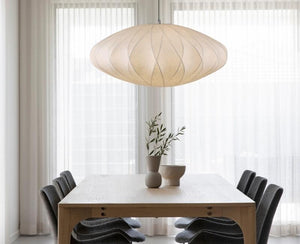
Pendant lights should typically hang 70–90cm above the surface of the dining table. This height provides enough light for dining while keeping the pendant visually comfortable for people seated around the table.
If you are using a single statement pendant, centre it directly over the middle of the table.
If you are installing multiple pendants, space them evenly so the light is distributed across the table without feeling crowded.
Kitchen islands often work best with two or three pendants, depending on the island length.
A helpful guideline is:
Pendant lights should generally hang 75–90cm above the countertop and be spaced 60–75cm apart for a balanced look.
This spacing helps create even lighting across the work surface while maintaining visual harmony.
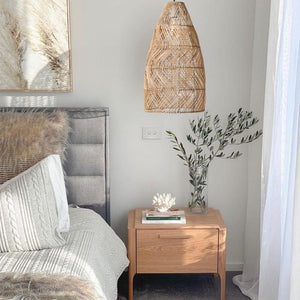
Pendant lights beside the bed are a stylish alternative to bedside lamps and are often used in modern and hotel-inspired interiors.
When installing bedside pendants:
This placement keeps the light functional while maintaining a clean, uncluttered bedside surface.
In entrance areas or stairwells, pendant lights often act as a statement feature.
For standard ceiling heights, ensure the bottom of the pendant hangs at least 2.1m above the floor so people can walk comfortably beneath it.
In double-volume spaces or staircases, larger pendants or clusters can be used to create visual impact and fill the vertical space.
When installing more than one pendant, symmetry and spacing are important.
A useful rule is to:
Taking a little extra time to measure spacing before installation can make a significant difference to the final look.
The pendant should be large enough to visually anchor the table but not extend beyond the table edges. A single statement pendant or a pair of pendants often works well depending on the size of the table.
Yes. Pendant lights are increasingly used as an alternative to bedside lamps. Hanging pendants beside the bed frees up space on bedside tables while creating a modern, hotel-inspired look.
Warm white light around 2700K–3000K is typically the best choice for most decorative pendant lighting. It creates a softer and more welcoming atmosphere in living spaces and dining areas.
Consider both the size of the pendant and the length of the suspension. Rooms with higher ceilings can accommodate longer drop pendants or clusters, while lower ceilings may require shorter or more compact designs.
Pendant lights are often used as feature or task lighting rather than the only source of light in a room. Combining pendant lights with ceiling lights, wall lights or lamps helps create balanced, layered lighting.


