CUSTOMER SUPPORT
087 711 5767
087 711 5767

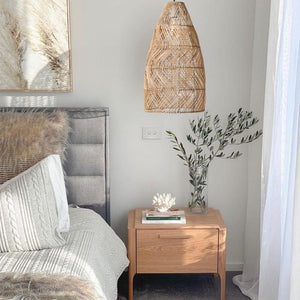
Most lighting materials do one job: they contain the bulb and diffuse the light evenly across a shade. Glass does it. Fabric does it. Frosted acrylic does it too, just less elegantly. Woven and rattan lighting does something different. It filters light through a structure that's never perfectly regular, so the light itself comes out scattered, dappled, and constantly shifting depending on the angle you're standing at and the time of day. A woven pendant isn't just a different-looking object switched off. It changes the character of the light in the room switched on.
That's the real reason woven and rattan lighting keeps showing up in South African homes that otherwise look nothing alike, from a Camps Bay apartment to a Joburg suburb renovation to a Garden Route guest house. This is a practical guide to the category: the materials, the quality of light each one produces, and where they actually work in a home.
There's a tactile appeal to natural fibre that glass, chrome, and plastic simply don't have. Rattan and cane have warmth and grain you can see and feel, and no two woven shades are ever quite identical. That slight irregularity, a strand sitting a little differently here, a gap in the weave there, is part of the appeal rather than a flaw. It's what makes a woven pendant read as made rather than manufactured.
Then there's what it does to the light. A glass or fabric shade diffuses evenly: the light comes out softened but uniform. A woven shade filters unevenly, and that unevenness is the whole point. Look at the wall or ceiling near a lit rattan pendant and you'll usually see a pattern of light and shadow moving subtly as the room's air shifts or as you walk past it. It's a quality of light that no other common lighting material produces, and it's why a woven fitting often feels more alive in a room than something technically brighter.
The natural, earthy tones of rattan, cane, and similar fibres also sit comfortably against almost any wall colour, which is part of why the category works in so many different South African homes and doesn't demand a full natural-material overhaul to look right.
"Rattan" gets used loosely to describe a whole category of natural woven lighting, but the materials underneath it behave quite differently from one another.
Rattan is a solid, flexible vine, not a grass, traditionally woven by hand into curved, structural forms. It's the most premium and durable of the natural weave materials commonly used in lighting, holds its shape well over time, and produces a soft, relatively even glow when tightly woven. It suits both a considered, Japandi-leaning room and a more relaxed, layered space equally well.
Cane usually refers to the outer skin of the rattan vine, often used flat or in a more open, lattice-style weave, similar to the caning you'd see on furniture. It's lighter and more delicate-looking than a solid rattan weave and throws a slightly more pronounced pattern of light through its more open structure.
Wicker is technically a weaving technique rather than a material on its own. It can be made from rattan, willow, or other fibres, and the term gets used loosely on most product listings to describe any woven natural-fibre shade. Worth checking the actual material behind a "wicker" listing if durability matters to you.
Seagrass and jute are softer, more casual natural fibres, usually woven more loosely than rattan. They give a more relaxed, coastal or bohemian character, and their open weave produces a much more dramatic, dappled scattering of light and shadow than a tighter rattan shade would.
Bamboo is a fast-growing, sustainable material most often used in slatted or ribbed lighting forms rather than a tight, traditional weave. It gives a cleaner, more architectural look than rattan, with light escaping through regular gaps rather than an irregular hand-woven pattern.
The practical takeaway: the tightness of the weave is what actually determines the light quality. A tightly woven rattan shade, like the Valley Natural Rattan Pendant Light, gives a soft, even glow with only subtle texture. A more open weave, the kind you'll find on looser seagrass or wicker shades, throws a far more dramatic, patterned light across the surrounding walls and ceiling.
Living room. A woven pendant works well as a central feature, especially hung slightly lower than a conventional ceiling fitting so its texture and pattern are actually visible from a seated position. A rattan-shaded floor lamp beside a sofa is an easy second layer. Both work especially well in rooms that already lean toward natural materials, timber floors, linen upholstery, stone surfaces, rather than fighting against a room full of glass and chrome.
Bedroom. Smaller woven pendants or table lamps either side of the bed suit the softer, more relaxed atmosphere a bedroom needs. The Adaya Small Rattan Pendant and the Aalto Woven Rope Rattan and Amber Glass Pendant both work at this smaller, more intimate scale.
Dining room. This is one of the strongest applications in the whole category. A woven pendant hung low over a dining table throws a genuinely beautiful, ever-changing pattern of light across the table surface and the walls around it during an evening meal, in a way a plain glass or fabric shade never will. The Vanatu Large Black and Natural Rattan Pendant Light makes a strong statement piece here, while the Adille Small Rattan Twine Pendant works for a smaller table or a more understated look.
Entrance hall. A rattan or cane pendant gives a warm, textural first impression the moment someone walks in, particularly useful in South African entrance halls that tend to be neutral, pale, and a little short on visual warmth.
Outdoor and covered patio. Natural fibres need protection from direct rain and harsh UV, both of which are in good supply across most of South Africa for a large part of the year. A covered stoep, an undercover patio, or a braai area with proper roof coverage are all fine for a woven fitting. A pergola with open slats, a fully exposed deck, or anywhere that gets driven rain is not; stick to purpose-built outdoor fittings in those spots instead.
Natural fibre lighting isn't maintenance-free, and it's worth being honest about that upfront rather than discovering it the hard way.
Rattan and cane hold up well indoors and in genuinely covered outdoor areas, but prolonged direct sun exposure and driving rain will dry out and eventually crack the natural fibres over time. This matters more in South Africa than in a milder climate, given how intense direct sun can be across most of the country for much of the year.
Coastal and humid environments, KwaZulu-Natal's humidity or Cape Town's wetter winter months, are generally fine for indoor use, but it's worth periodically checking a woven fitting for any early signs of the fibre drying out or splitting, especially if it sits near a window that gets a lot of direct sun.
For cleaning, a light dusting or an occasional pass with a vacuum's soft brush attachment is usually all a woven shade needs. Avoid soaking it or using harsh chemical cleaners on the natural fibre, both of which can damage the weave.
Done properly, well-made woven lighting lasts for years and, much like timber, often develops a more attractive, slightly warmer tone as it ages rather than simply wearing out.
Woven and rattan pieces pair naturally with timber, linen, stone, and other natural materials, but they're just as useful as a counterbalance in a room that leans harder and cooler. A living room dominated by concrete, glass, and chrome often just needs one woven piece, a pendant or a floor lamp, to soften the whole space without requiring a full natural-material overhaul.
It works well as a single natural-texture anchor in an otherwise contemporary or minimal room. You don't need every surface to be rattan for the material to read as intentional; one well-placed piece does the job.
Mixing multiple woven pieces in the same room, a pendant and a floor lamp together, for instance, works well as long as the weave tightness and tone stay reasonably consistent. Pairing a very tight, fine rattan weave with a loose, chunky seagrass weave in the same space can start to feel visually busy rather than layered.
A woven or rattan fitting does something no other lighting material really can: it makes the light itself feel alive, shifting slightly through the day the way natural materials always do. Start with the rattan and natural fibre lighting collection for the full range of pendants and floor lamps, pair whatever you choose with a warm 2700K bulb to bring out the natural tone of the material properly, and if you're drawn to the wider natural-material aesthetic beyond just the weave itself, the Japandi lighting collection is worth a look too. Nationwide delivery is available across South Africa.