CUSTOMER SUPPORT
087 711 5767
087 711 5767

There's a particular feeling to a well-done Japandi room: calm, warm, and completely uncontrived. Nothing is shouting for attention, yet every object feels chosen. Most people trying to achieve this look get the furniture right and the palette right — the low sofa, the linen, the pale oak, the greige walls — and then undo all of it with a recessed LED grid running at a cold 4000K, which makes the whole room feel less like a considered home and more like a premium office reception.
Lighting is where Japandi is most often lost, and it's also the easiest part to fix. This is a practical guide to the six lighting principles that actually define the Japandi look, and the specific choices that deliver them in a South African home.
Japandi is the meeting point of Japanese wabi-sabi — beauty in imperfection, natural materials, an acceptance of age and patina — and Scandinavian hygge, the warmth and cosiness of gathered light on a cold evening. That combination produces a lighting approach that's both more demanding and more forgiving than most styles.
More demanding, because the fittings have to be made from genuinely natural materials, not convincing plastic pretending to be rattan or a polished chrome standing in for something warmer. Wabi-sabi is essentially an authenticity test: does this material have a life of its own, or is it performing one?
More forgiving, because Japandi light itself is warm, diffused, and imprecise. There's no attempt to illuminate every corner evenly, no showcase aesthetic. A Japandi room at night should feel like somewhere safe and warm to be — not like a product launch.
The six rules below aren't arbitrary style preferences. They're the direct, practical translation of wabi-sabi and hygge into lighting decisions.
This is the single most important specification in a Japandi space. 2700K is the colour temperature of candlelight and early morning sun — warm, golden, and inherently calming. It's what makes natural materials look alive: the grain in a pale oak shelf, the texture of a linen sofa, the imperfect surface of a hand-thrown ceramic bowl.
4000K is the enemy of Japandi. It's the temperature of offices, hospitals, and fluorescent kitchens, and under it, natural materials look bleached and inert. Every light source in a Japandi space — pendant, table lamp, floor lamp, wall sconce, any under-shelf strip — should run at 2700K.
3000K is an acceptable compromise where functional clarity actually matters, like a kitchen work surface or a bathroom vanity. In purely atmospheric rooms — living room, bedroom, dining room — stay at 2700K without exception.
Practical step: check every bulb in your home against this standard right now. Anything running 4000K or above should be swapped for 2700K warm white LED bulbs before you buy a single new fitting. It's the most immediately impactful change available, and it costs nothing beyond the bulbs themselves.
A Japandi pendant shouldn't cast a hard-edged pool of light. It should diffuse — the shade itself glows, and the light it casts has soft, gradual edges rather than a defined beam. This is why natural material shades matter so much: rattan and cane let light filter through the weave, ribbed glass or paper spreads it across the surface, ceramic softens and warms it further still.
Direct lighting — exposed GU10 spotlights, bare-bulb pendants (unless the visible filament is itself the point), undiffused recessed downlights — works against everything Japandi is trying to do. It creates contrast, defines hard edges, and makes a room feel designed for performance rather than for living in.
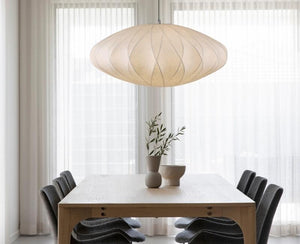
A simple test: if you can see the bare light source clearly from where you'd normally sit, the diffusion isn't doing its job. The Summerhill Japandi Ribbed Dome Pendant Light is a good benchmark here — a ribbed white dome with a warm wood collar that casts genuinely soft, diffused light rather than a beam.
Every fitting in a Japandi space should be made from a material that exists in nature and ages with character rather than degrading into ugliness. The right materials: rattan, cane, bamboo, ceramic, stoneware, marble, travertine, linen, paper, jute, untreated or lightly oiled timber, and raw brass that's allowed to patina rather than staying polished — that patina is correct, not a flaw.
The wrong materials: chrome, polished stainless steel, high-gloss lacquer, acrylic, and polycarbonate shades trying to look organic without actually being it.
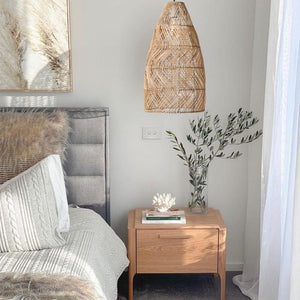
This is where Japandi most commonly goes wrong in SA homes — the pendant shade is the right shape but the wrong material. A drum shade in white polycarbonate isn't Japandi; the same shape in linen is. A dome pendant in brushed chrome isn't Japandi; the same form in ribbed opal glass or white-glazed ceramic is. For the fitting itself, the Valley Natural Rattan Pendant Light and the Vanatu Black and Natural Rattan Pendant Light both do this well — genuinely hand-woven, with the irregularity in the weave that machine-perfect versions never have.
For table lamps, the material test applies just as strictly. The Sodwana Boulder Textured Ceramic Table Lamp — a stacked, sculptural ceramic base with a deliberately organic, textured finish — is probably the most authentically wabi-sabi object on this list. The Kiva Black and Travertine Marble Table Lamp does the same job in stone, with the natural variation travertine is known for.
Low furniture changes the entire geometry of how a room should be lit. Japandi sofas typically sit at 35–40cm, which puts a seated guest's eye-line around a metre from the floor. A single pendant 2.5m up leaves a metre and a half of unlit air between the furniture and the light source — the room feels disconnected, lit from a ceiling that has nothing to do with where people actually are.
The fix is to layer three sources at different heights:
This triangle is what produces the specific quality of light that defines a good Japandi evening: warm, multi-directional, dimensional. No single source dominates, and the room glows from around the furniture rather than being lit from above it.
A Japandi space should move from daytime clarity to evening intimacy without changing a single fitting — just a dimmer. This transition is part of the hygge philosophy itself: the deliberate modulation of light as a small act of care for whoever's in the room.
Practically, that means every hardwired fitting — pendant, downlight, wall sconce — should sit on a compatible dimmer circuit, and table and floor lamps should run dimmable LED bulbs. Where a space genuinely needs to switch between functional and atmospheric use, colour-temperature-adjustable (CCT) sources can help — though in a pure Japandi room this matters less, since 2700K is the answer throughout regardless of time of day.
The Japanese concept of "ma" — purposeful negative space — applies to a lighting plan just as much as to furniture layout. A room with a lamp in every corner, a pendant over every surface, and a spotlight on every wall isn't Japandi. It's maximalism that happens to use natural materials.
One pendant, well chosen and correctly positioned. One floor lamp, in the right corner rather than every corner. One table lamp, exactly where someone actually sits to read or talk. The spaces between fittings are as considered as the fittings themselves — a dark corner in a Japandi room isn't a failure, it's intentional shadow, the spatial equivalent of a rest in music.
Before adding any light source, it's worth asking one honest question: does this add to the calm of the room, or does it add to the noise?
Living room. One pendant over the coffee table area, hung low at 700–800mm above the surface. One floor lamp beside the main seating, shade at mid-height. Optionally, a rechargeable lamp on the coffee table as the evening's final layer. Everything at 2700K, everything dimmable. An overhead fitting is optional, and often better left out entirely — a Japandi living room is lit from within the furniture zone, not from above it.
Dining room. A single pendant over the table at 700–800mm above the surface — the most considered fitting in the house, and the one where material, diffusion, and scale all matter most. Rattan, ribbed glass, ceramic, or linen. 2700K, dimmable.
Bedroom. Two bedside sources rather than one overhead — a wall-mounted reading light or a small ceramic table lamp on each side. Any overhead fitting should be minimal and heavily diffused, or absent altogether. 2700K throughout, no exceptions.
Kitchen. The one space where 3000K is acceptable at the work surface for task clarity, with an under-cabinet LED strip at that temperature. Over an island or dining peninsula, a proper Japandi pendant — the ribbed dome or a rattan shade — at 2700K, as the atmospheric layer over the functional base.
Study or reading corner. A single arc floor lamp directed at the reading chair, 2700K and dimmable. No overhead needed. The concentrated warmth of one lamp over a chair and a small side table is Japandi hygge in its purest form.
Good Japandi lighting doesn't ask for attention. It just makes everything else in the room feel right — the grain in the wood, the weave in the linen, the quiet of the evening. Start with the Japandi lighting collection for a curated shortcut through the rattan, ceramic, and natural material pendants, table lamps, and floor lamps that actually meet this brief, or browse the natural and rattan lights range on its own. Nationwide delivery is available across South Africa.